
|
Eager Space | Videos by Alpha | Videos by Date | All Video Text | Support | Community | About |
|---|
Welcome to Eager Space
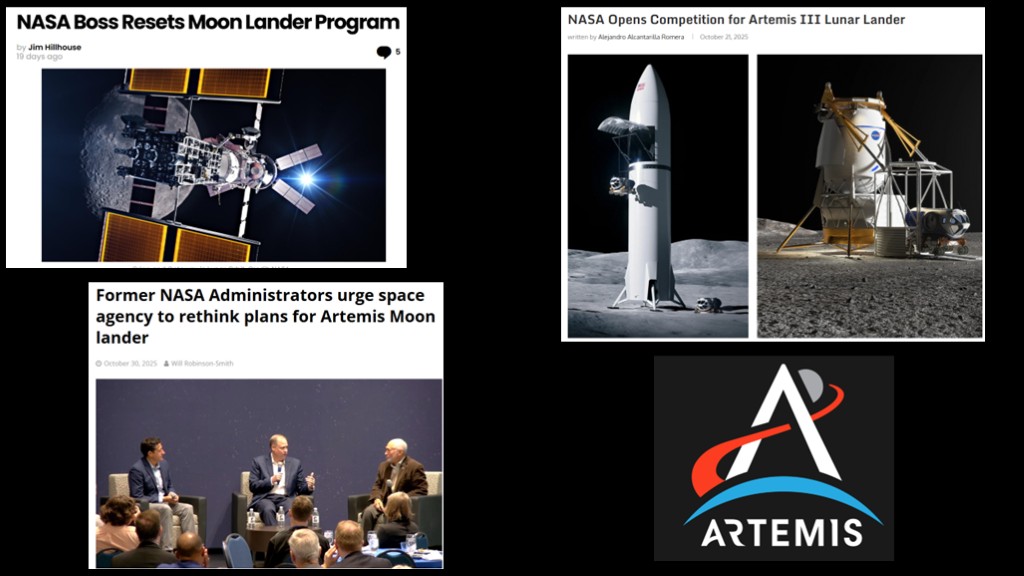
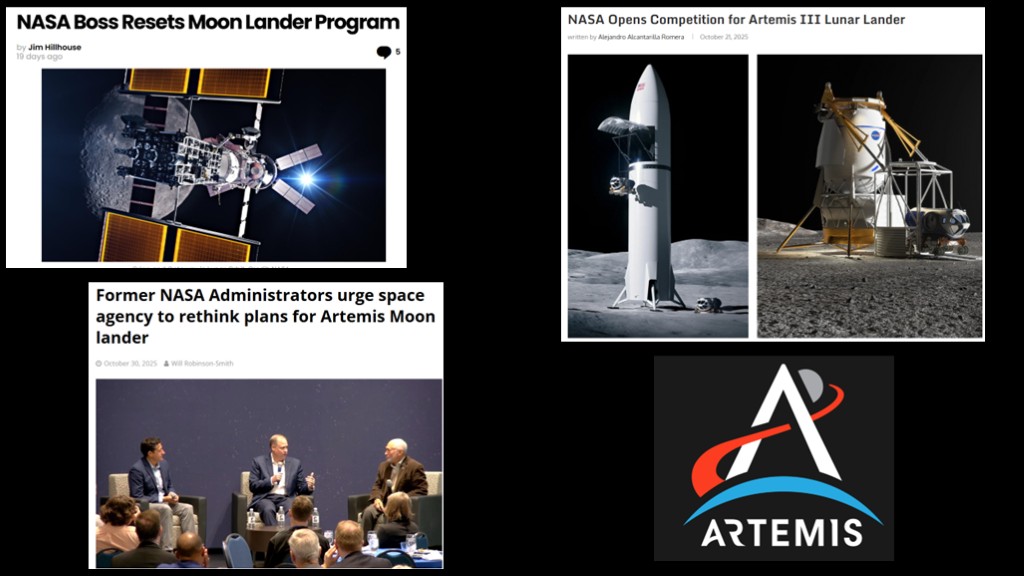
You've probably seen the news about NASA opening a new competition for the Artemis III lunar lander, a mission currently assigned to SpaceX's starship-derived HLS lander.
This is big news. Why is it happening?
Let's ask our AI friends...

I asked Gemini, Copilot, and Grok, and they gave consistent answers.
Starship is late, probably too late to beat China to the moon. We therefore need to foster competition to get back to the moon quicker and ensure that we have redundancy.
Suffice it to say that these aren't the real reasons, not the real reasons at all.
The real reason isn't surprising...

If we follow the money, we can understand what happened.
And I'm going to need to rewind back about 15 years.

The Constellation program started under President GW Bush in 2005 and was designed to take astronauts back to the moon. It would develop two new rockets, the super heavy lift cargo rocket Ares V and the heavy lift Ares I rocket.
Well, not actually new - they used as many shuttle parts as practical.

President Obama commissioned an independent review of NASA programs that concluded, in effect, "Constellation isn't going to happen in the way you want it to happen because you simply DO NOT have the budget to go to the moon and do the other things you want to do".
Obama therefore cancelled the program. It likely didn't help that constellation had accomplished very little in the 5 years that it was running.
If you've watched my other videos, you might recall that I've said that the president doesn't control NASA, and that meant that Obama actually couldn't cancel Constellation because he didn't control the money - congress did.

The problem was that the shuttle program was a cash cow for the companies that flew shuttle.

Most of the NASA centers worked on some aspect of shuttle, and Johnson, Marshall, and Kennedy had big stakes in the program.
The congresscritters who represented districts that had NASA contractors or NASA centers got money for their campaigns and lobbying paid for by those contractors.

This is what Eisenhower called the Military Industrial complex, though in this case it's the NASA industrial complex. Shuttle contractors, NASA centers, and politicians all wanted to keep the money, careers, jobs, and votes flowing.
Constellation had done that quite well, but Obama had cancelled it.
What they needed was a new rocket program.

An obstacle was NASA administrator Charles Bolden. He was a Marine corp major general and veteran astronaut who flew on four shuttle missions and that might mean that he actually cared about effectiveness.
The lobbyist therefore wrote a very special bill - sorry, I misspoke - *congress* wrote a very special bill.
They directed NASA to develop a rocket that could carry at least 130 tons to low earth orbit in preparation for missions beyond LEO, and a crew vehicle that could fly on that rocket for trips to ISS and beyond. The rocket was named the space launch system, and the crew vehicle was a continuation of the Orion capsule that was under development during constellation.
What was readily apparent was that this was a rocket without a mission. It's not a "land on the moon" rocket because congress neglected to fund a lander, so at best it's a "go into lunar orbit and come back home rocket".
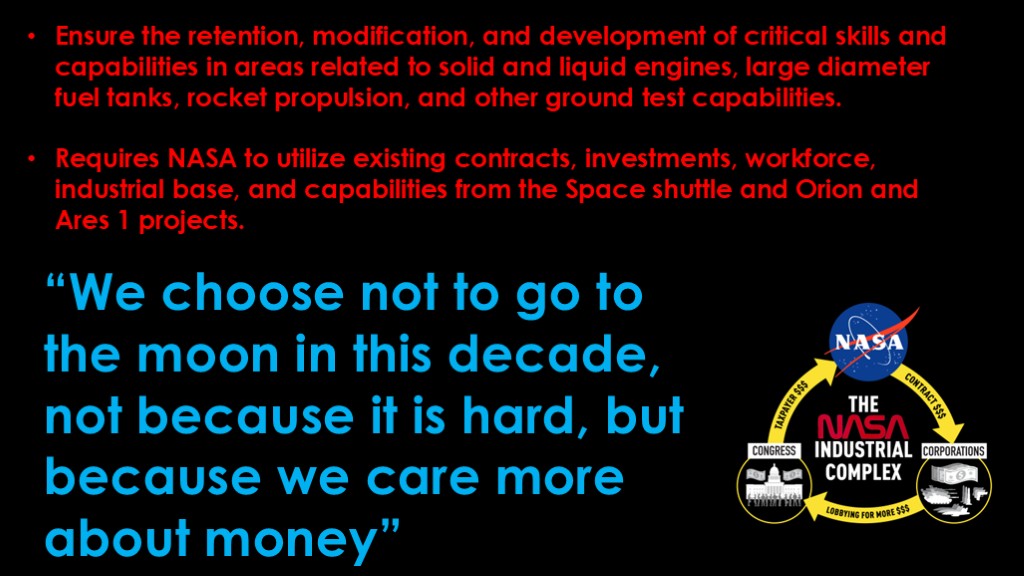
To ensure that nobody could do something the NASA industrial complex didn't want, the bill included the following requirements:
(read)
The lobbyists - I mean congress - wanted to be very sure that SLS would have to be shuttle derived, and that was just fine with NASA upper management and the contractors that were also part of the NASA industrial complex.
To butcher Kennedy badly, (read).

SLS and Orion were never about the moon. It was all about reinforcing the status quo that started back in shuttle.
And from 2011 to 2017, development went on. Congress gave SLS about $18 billion in funding. Orion got less per year but it had a 5 year funding head start, so it had $14 billion spent on it.
That's $32 billion funneled into NASA centers, NASA contractors, and back to politicians.
I was incorrect when I said SLS and Orion didn't have a mission. They did have a mission, just not one in space.
This state of affairs lasted until 2017...

In 2017 somebody looked at the current situation and said "if we are going to spend $32 billion on rockets and spacecraft it might be nice to go somewhere. Why don't we go back to the moon?", and the Artemis program was born.
Sort of. The real goal didn't change, but NASA would need to add a way to get to the lunar surface for people to take them seriously.

NASA said "if we can't make it we'll need to buy it", and created the human landing system program.
It was a truly ludicrous idea.
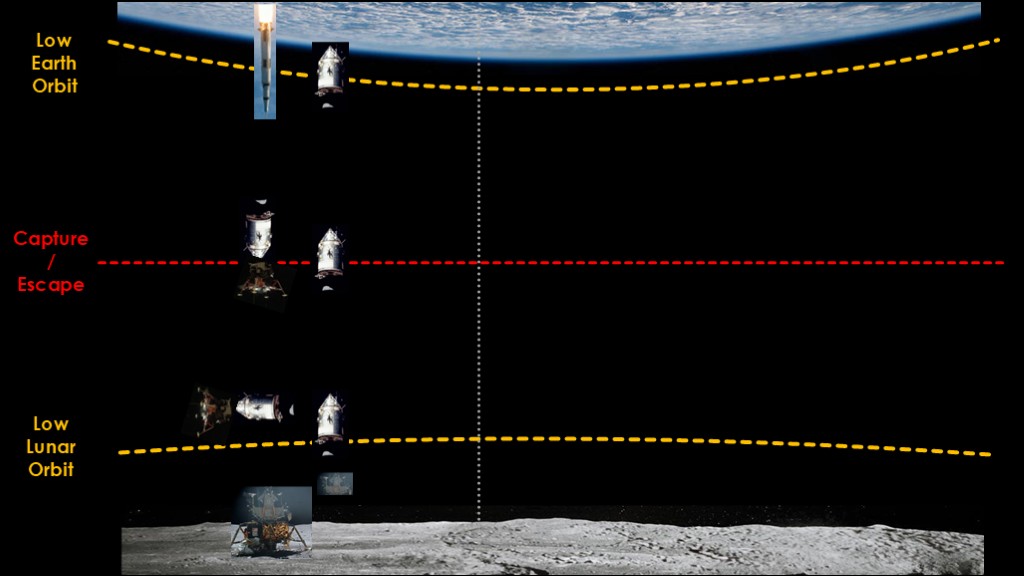
To explain why, we'll need to look at the Artemis lunar architecture.
For Apollo, the huge Saturn V rocket tossed the command/service module and the lunar module towards the moon and the service module braked the whole stack into low lunar orbit. The lunar module went down to the surface, astronauts did stuff, and then the top half returned to low lunar orbit, docked with the command/service module, and the command service module headed back home.
A complex architecture that made it barely possible. Getting to the moon and back is very hard.
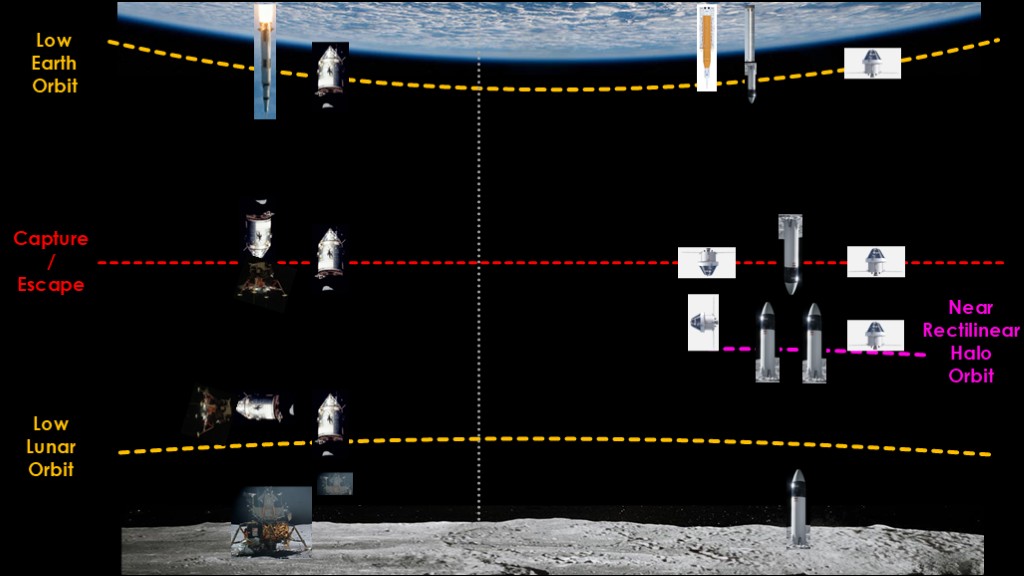
But for Artemis, remember that SLS and Orion weren't actually designed to do a lunar mission.
SLS can toss Orion towards the moon and Orion can put itself in a lunar orbit, but it's a weird elliptical orbit known as the near rectilinear halo orbit. It's farther away from the lunar surface than the low lunar orbit.
The reason for that orbit is that Orion is much less capable than the Apollo command/service module. It can't get into low lunar orbit and be able to return to earth so it is stuck with this weird orbit.
What NASA asked for was a lander architecture that would send some sort of lander on the way to the moon - I'm showing starship here - and that lander needed to be able to stop in near rectilinear halo orbit, pick up the astronauts, take them to the surface of the moon, keep them alive and happy for a week, and get them back up to near rectilinear halo orbit so they could hop back into Orion for the trip home.
That means that the lander has a harder job than SLS and Orion. A *much* harder job.

NASA got three proposals for landers.
Dynetics bid a lander design that would cost $9 billion to develop, though it was unclear whether it had the thrust to get off of the moon.
Blue Origin formed the "national team" with Lockheed Martin, Northrop Grumman, and Draper. They had what looked like a decent approach and they bid $6 billion for it.
SpaceX bid a ridiculously large variant of their planned starship second stage but they only bid about $3 billion and that was the bid that NASA selected.
The Dynetics bid was only about 30% of what NASA had already spent on SLS and orion, and the SpaceX bid was only 9%.
Now here we are in 2025, with the cost of SLS over $31 billion and Orion over $25 billion, a total cost of $56 billion. And that's in actual dollars, if you adjust inflation, that's $66 billion in 2025 dollars.
And now we can come back to our original question. Why is there so much concern about the program right now?
Let's revisit those reasons...

Is it because SpaceX is slow, because starship is late?
NASA "Mega Moon Rocket" has flown once, on the Artemis 1 mission three years ago.
I had to go and check. The full starship stack has flown 10 times since Artemis 1 flew (it's 11 times if you think flight 1 counts)

Is it because they want redundancy?
That would be a good argument when HLS was the only game in town, but Blue Origin lobbying led to the sustaining lunar development lander program, which Blue Origin won.
Two landers seems like enough redundancy.

Is it to foster competition?
Once again *two landers*.

Is it to beat China?
China has been very open about their program and their timeline, and there was very little mention of China's moon ambitions back in 2019, when Artemis was new.

So if it's not those reasons, what is it?
Why all the pushback right now...

The first is that Artemis is late.
Not just late, but late late.
Three years and over $11 billion spent on SLS and Orion between Artemis 1 and Artemis 2, scheduled for no earlier than February of 2026.
If you are planning on flying astronauts once a year, a three year gap is troubling.

Some of the delay is from trying to resolve the Orion heat shield issues from Artemis 1.

Missions beyond Artemis 3 require SLS Block 1B, which replaces the comically undersized ICPS upper stage - stolen directly from the Delta IV rocket - with the much bigger appropriately sized exploration upper stage.
EUS will get SLS closer to the 130 tons to LEO that congress decreed. Which is a good idea in concept, but it turns out that it will likely cost nearly $5 billion by the time it is completed. That is a stack of $100 bills about 3 miles tall.
That is impressively expensive.
And that's spending zero dollars to develop engines as EUS uses the RL-10 upper stage engine.

SLS uses a mobile launch platform.
Mobile launcher 1 was developed for the Constellation program for $ 234 million and then subsequently modified for SLS for an additional $ 693 million.
This platform only supports block 1 SLS because NASA was concerned that modifying it for later SLS versions would slow the program down.
SLS block 1b requires a brand new mobile launcher. Originally estimated at $ 400 million, it is now projected to cost $2.7 billion.
So that's $3.6 billion for launch platforms and towers.
For comparison, here's another big tower, the Burj Khalifa. It was completed in 2009 for a total cost of approximately $1.5 billion.

But it's not like this is anything new for SLS and Orion.
The NASA office of the inspector general has produced many papers that are critical about the approach and progress of SLS and Orion.

And the government accountability office has weighed in with their opinion every year.
NASA responds to these reports and then nothing changes, because slow and over budget is the goal of SLS and Orion. It's supposed to be like that.
I would argue that the optics of this is worse now; after flying Artemis 1 it looks really bad that it's been 3 years and they have yet to fly the rocket again. But it's not a *lot* worse than it was before Artemis 1.
The real answer is that it is all about SpaceX and Starship.

But it's not at all about Starship being late. Starship being late is a *benefit* for SLS and Orion - it means that the status quo just persists and that means more money for the SLS and Orion folks and somebody else to blame it on.
It's something far worse...
It's the realization that starship will probably work.
SLS and Orion are predicated on the belief that they are doing something unique, something that can only be done through NASA.

SpaceX took flying astronauts away with Commercial Crew. It's been tremendously useful for NASA as it allows them to effectively use the International Space Station, but it seriously grates on the belief in NASA exceptionalism.

Starship is truly their worst nightmare.
As we saw SLS and Orion gets you the ability to put astronauts into near rectilinear halo orbit and bring them back home.

SLS and Orion plus Starship HLS gives you astronauts on the lunar surface, which is the stated goal of Artemis.
But once you have Starship HLS, (fade out SLS) you can get there without SLS and Orion.
That would be bad.

I talk about how that might be done in my commercial moon video.

The usual approach at this point is to try to convince the company that is moving too fast to slow down. If Starship slows down its progress, everybody can keep partaking in that sweet, sweet money.

The problem with that is that SpaceX's contract for HLS is a firm fixed price contract.
For the Artemis III contract, SpaceX has already collected $2.7 billion of the $3 billion that is obligated towards HLS Starship. There is a contract modification for Artemis IV that could net them another $1 billion for that mission.
Even if SpaceX wanted to play along - and I don't think that's a SpaceX thing to do - they have little incentive to do so.
So getting them to slow down is unlikely to work.

That's why the goal of the campaign is to somehow replace Starship HLS in at least the early lunar landing missions...

Maybe it will slow spacex down, but even if it doesn't we might get a nice contract out of it, and another lander gives us something to lobby for in the future

Lockheed Martin says that they can take parts of Orion and build this lunar lander in only 30 months - as long as they have a Cost Plus contract. And they'll figure out a descent stage that can take this ascent stage to the surface.
How big might their lander be?
The Apollo lunar module massed about 16 tons and could generate about 4800 meters per second of delta v. That's enough oomph to get from low lunar orbit to the surface and back to low lunar orbit.
The Artemis lander comes from near rectilinear halo orbit, which means it needs an extra 900 meters per second. And it probably also needs to be able to initially brake into near rectilinear halo orbit as well for another 450 meters per second.
That puts the estimated mass of the Lockheed lander at a minimum of 19 to 21 tons. That's assuming that the lander is as mass optimized as the lunar module was. Seems unlikely since it's going to be built of pieces from Orion and the lunar module engineers spent years making it light enough.

Now you have another problem. SLS block 1 can't carry the lander, and that's all you have for Artemis III. You need a different rocket.
Falcon Heavy *might* be able to get your lander there, though SpaceX doesn't publish its payload to the moon.
New Glenn is another possibility. We don't know for sure because Blue Origin hasn't published payload values for new Glenn in many years.

The proposed crew variant of the blue moon mark 1 lander also needs to get to the moon.
It has a launch mass of 45 tons, and it can supposedly take 20 tons to the lunar surface and make it back out to orbit. That seems possible at first glance - you can do a lot with 20 tons of payload - but that assumes that the 20 tons are all left on the surface. All the crew accommodations need to go down to the surface and come back up again, and that will reduce the payload to the surface significantly.
Can it be done? The best answer right now is "maybe", as we don't know what Blue Origin will submit, nor whether New Glenn or Falcon Heavy can launch it to the moon in a single shot.

Not to be outdone, SpaceX released an update titled "To the Moon and Beyond" that featured this rendition of a starship crew quarters.
They also said that they are working on a simplified Artemis III architecture.

Where does that leave us?
Let's rank the proposals...

Lockheed Martin's "30 month wonder" approach.
Given that they are advocating a cost plus approach and we know how quick that has been with Orion, I see little chance of this being ready in 30 months. This - and any other proposal by current SLS contractors - is clearly what the nasa industrial complex is hoping for.
They would need SpaceX or Blue Origin to launch it for them.

Blue Moon Mark 1.crew seems possible. Timeline would be tight and it's important to note that Blue has never flown spacecraft with full crew life support.

We don't know enough about Starship.Simple to have any idea, but it's pretty clear that those driving for a replacement for Starship will do everything in their power to have that not be a simpler version of starship

Can a replacement lander be ready for Artemis III?
This is how the timeline worked out for the HLS contract.
The RFP went out in April of 2019, SpaceX was selected 2 years later in April of 2021, and it took 6 months to get through legal issues before work could actually start.
Note that this approach included a 10 month design phase that ran from April 2020 to April 2021.
So, RFP to selection is about a year, if there are protests and suits add on 6 months or so.

For artemis III, they can reuse documentation from the previous lunar lander RFPs but they are going to need time to adapt it to this new approach, deal with shutdown hangover, and work around the holidays. My target for the RFP is February of 2026.
The deadline will likely be in August of 2026; there are a *lot* of requirements to create a valid submission and I don't see it being shorter.
It seems unlikely NASA will include a design phase - another reason the submission period will need to be 6 months. The evaluation took 5 months for HLS; I'm going to compress it and assert they can get it done in three months by November 2026, but it could easily be longer.
At this point, somebody is going to protest. Lockheed Martin will protest if they lose because their world is better if things take longer, SpaceX will protest because slowing this down makes the reaward look stupid, and Blue Origin will protest because they always protest.
I'm going to assume that the protests are denied in 3 months because of the holidays, and work starts in February 2027.

Let's look at the current planned dates for Artemis...
Artemis III in mid 2027, Artemis IV in September 2028, Artemis V in March of 2030, and Artemis VI in March of 2031. There's a big gap between IV and V to give Blue Origin time to finish their lander.
Let's assume Congress plays some games and rewrites the legislation to require a new lander that is based on Orion, essentially gifting the program to Lockheed Martin.
If the project was awarded *today*, Lockheed Martin would have 19 months to design, build, and presumably do a test flight to the moon.
The assert they can do it in 30 months, or about in time for Artemis IV. The only world in which that works is one where Artemis III slips into 2028, which is certainly possible but increases the chance that Starship is ready.
The problem here is that both SpaceX and Blue Origin are likely going to sue NASA and they likely are going to win because it's pretty clear that going directly to Lockheed Martin is an illegal award. SpaceX won a similar suit when NASA wanted to award money to Kistler for commercial cargo.
If the procurement cycle runs the way I expect, work likely starts in February of 2027, given the vendor 5 months to hit the Artemis III deadline. If they took 30 months it would push out to Artemis V.
That makes the Lockheed Martin "30 month wonder" plan very suspect - it doesn't get done early enough and - assuming it's a cost plus contract - it requires a ton of work on both sides to track and verify what the costs are, work that isn't going to getting done quickly. And it's certainly not going to be cheap.
Ironically, if you really want to get to the moon faster you need to choose SpaceX or Blue Origin as they are already working on landers and therefore are the farthest ahead. Since that's not how this whole thing started it's pretty clear that the goal isn't actually to get to the moon sooner, it's to preserve the NASA industrial complex...

Advocates for SLS and Orion are fighting a losing battle. In 2010 their only competition was Atlas V and Delta IV, but Starship and New Glenn are already flying and Nova and Neutron will likely join them in the next year.
The commercial space act of 1998 says the following:
(read)
The nasa industrial complex could sidestep that requirement for SLS and Orion because there was no defined mission and insufficient commercial capability to do big missions.
But now we have big private rockets, reusable smaller rockets, and private astronaut capsules it's a much harder argument to sell.

We can therefore expect two things.
The first is that NASA will never design another rocket themselves.
The second is that the NASA industrial complex will do their best to milk SLS and Orion for as long as possible...
Being late and overbudget is a feature, despite all protestations to the contrary.

That's all for this video.
Your music selection for today is Rush's "The Big Money", off their 1985 Platinum release, Power Windows...